Structural Function
All sounds go through the same basic auditory pathway, but different types of sounds (speech, music, noise) activate different brain networks. Even within pitch perception, the brain uses multiple systems, and scientists are still discovering how these systems are organized.
Limb (2006)
Study suggests that the primary auditory cortex isn’t just passively receiving sound — its structure (how dense or developed it is) relates to how well people perceive musical pitch and other aspects.
Auditory Cortex and Beyond
From Primary to Secondary Processing
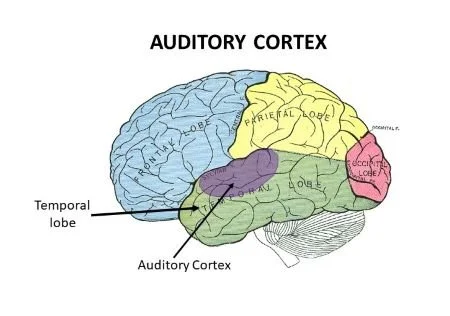
The primary auditory cortex (which contains Heschl's gyrus bilaterally, Brodmann area 41) receives incoming sound input and then relays sound to the appropriate processing centers, including secondary auditory association centers along the planum temporale
Neuroanatomical research (Limb, 2006) shows that the primary auditory cortex — particularly Heschl’s gyrus — is structurally linked to musical aptitude: individuals with more gray matter in this region tend to have stronger pitch perception.
But music perception goes far beyond basic sound. Limb’s review highlights that secondary auditory areas, such as the planum temporale, contribute to specialized perceptual abilities like perfect pitch, and that these areas exhibit anatomical asymmetries related to this skill.
Finally, studies suggest hemispheric specialization: different sides of the brain/processors might be more tuned to aspects like melody versus rhythm
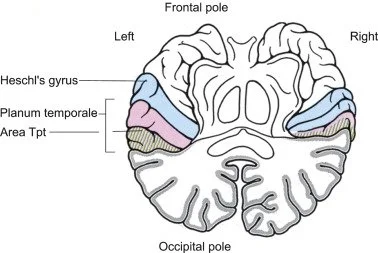
Heschl’s Gyrus: Primary auditory cortex: structural differences (e.g. gray matter volume) here correlate with musical aptitude.
Planum Temporale: shows anatomical asymmetries that relate to skills like perfect pitch.
Broca’s Area: often associated with language; also active when assessing musical structure (e.g. detecting whether notes are “in-key”)
Key Brain Regions Involved in Music Perception
Overlaps Between Music, Language, Emotion, and Brain Plasticity
Music perception overlaps with language processing: both involve hierarchical and syntactic processing.
Music taps into emotion and reward circuits — explaining why music can be moving, motivational, or mood-altering.
Variation across individuals (e.g. musical training, aptitude) links to structural brain variation — showing that brains adapt to musical experience.